

Gravel roads don’t automatically call for a 4x4, but they do change what you should look for in a car. We compare hatchbacks, SUVs and 4x4s to see where ground clearance, traction, tyres and running costs really matter.
Key Takeaways
- Hatchbacks can handle maintained gravel well if they have enough ground clearance and suitable tyres.
- Compact SUVs suit drivers who regularly alternate between tar and rougher dirt roads.
- AWD improves traction on loose surfaces, while 4WD is designed for more demanding terrain.
- Ground clearance, tyres, suspension and drivetrain matter more than rugged styling.
- 4x4 vehicles offer greater off-road capability, but usually come with higher running costs.
- For mainly tar driving with some dirt roads, the condition of the unpaved section should guide your choice.
A gravel road can be anything from the smooth stretch leading to your favourite weekend spot to a rutted farm road that gets properly messy after a summer storm.
Naturally, the car you need for one isn’t necessarily the car you need for the other.
If you’re looking at all-terrain vehicles, or simply trying to work out whether a hatchback, SUV or 4x4 makes sense for your roads, the best place to begin is with the kind of driving you actually do.
You don’t need maximum off-road capability just because some of your driving happens away from tar. But once rough surfaces become a regular part of your week, things like ground clearance, tyres, traction and suspension start moving much higher up on the shopping list.
First, what kind of gravel road are we talking about?
There’s a big difference between maintained gravel and genuine off-road terrain.
A reasonably smooth dirt road with a few corrugations and potholes can be perfectly manageable in many ordinary cars. Add deeper ruts, washouts, mud, loose sand or steep sections, and you start asking much more of the vehicle.
A useful way to split it is:
- Maintained gravel: Hard-packed dirt, loose stones, corrugations and occasional potholes.
- Rough rural roads: Uneven surfaces, deeper potholes, ruts and sections that deteriorate noticeably after rain.
- Off-road terrain: Deep sand, mud, rocks, steep climbs and tracks where clearance and traction become essential.
That first category leaves plenty of room for a hatchback. The second starts making a compact SUV appealing. The third is where a proper 4x4 comes into its own.
Hatchback vs SUV vs 4x4 on rough roads
Here’s a broad comparison:
|
Vehicle type |
Ground clearance |
Gravel and dirt-road ability |
Everyday costs |
Best fit |
|
Hatchback |
Usually lower |
Good on maintained gravel |
Usually lowest |
Mostly tar with some gravel or dirt |
|
Compact SUV / crossover |
Usually higher |
Better suited to regular rough-road use |
Moderate |
A regular mix of tar and dirt |
|
4x4 |
Generally highest |
Built for much tougher terrain |
Usually highest |
Rough rural roads and proper off-roading |
There will always be differences between individual models, so the body style only tells you part of the story. A well-chosen hatchback can be perfectly happy on gravel, while an SUV with road-biased tyres and limited clearance may be less adventurous than it looks.
Hatchbacks can handle more than people think
If your gravel driving mostly involves maintained roads, there’s no reason to automatically rule out a hatchback.
For someone doing most of their mileage on tar, a hatchback can also make financial sense. They’re generally lighter, economical to run and fitted with smaller, more affordable tyres than larger SUVs and 4x4s.
The main limitation is clearance.
The difference in ground clearance between a hatchback and a subcompact SUV becomes noticeable over deep potholes, raised road sections, and ruts. The rougher your regular route gets, the more useful those extra centimetres underneath the car become.
Our Swift is a good example. As a compact hatchback, it has 145 mm of minimum ground clearance, so if you regularly drive one on gravel, deeper ruts and raised sections of road deserve a little more attention than they would in one of our taller vehicles.
Tyre choice matters here too. A sensible tyre profile with enough sidewall to absorb some of the impact from corrugations and potholes can make a big difference.
So, when comparing gravel-road hatchbacks or the best small cars for rough roads, check the ground clearance and wheel-and-tyre combination rather than simply assuming that small means unsuitable.

Why SUVs work so well for mixed driving
For many South African drivers, the sweet spot sits somewhere between a hatchback and a dedicated 4x4.
A compact SUV or crossover gives you extra ground clearance without automatically committing you to the size, fuel use or running costs of a traditional off-roader.
You can see that difference in the Suzuki range too. The Fronx has 170 mm of minimum ground clearance, while the Grand Vitara offers 210 mm. If potholes, ruts and uneven gravel are a regular part of your route, that extra clearance gives you more room to work with.
That’s especially useful if your normal week includes plenty of tar along with farm roads, gravel commutes or weekend trips out of town.
Take an 80% highway and 20% dirt-road commute. If that final 20% is rough enough to make clearance a regular concern but not so severe as to require serious off-road hardware, a compact SUV makes a strong case for itself.
Some SUVs also offer AWD, which can be useful when loose or wet surfaces start affecting traction.
Just remember that SUV doesn’t automatically mean 4x4.


What is the difference between an SUV and a 4x4?
An SUV is a vehicle type. A 4x4 describes a drivetrain.
An SUV can be front-wheel drive, rear-wheel drive, AWD or 4WD. Many modern compact SUVs are designed mainly for tar and gravel rather than serious off-road driving.
A traditional 4x4 vehicle is built to drive all four wheels and, depending on the model, may include features such as low-range gearing for difficult terrain.
So if you’re shopping for an SUV or off-road car, look past the shape and check what’s underneath. The drivetrain, clearance, tyres, suspension and off-road geometry will tell you much more about where it can comfortably go.
AWD vs 4WD for loose gravel and dirt
AWD comes into its own when the problem is grip.
It can send drive to more than one axle, helping the vehicle find traction on surfaces such as loose gravel, wet dirt and slippery roads. That makes AWD hatchbacks and crossovers useful for drivers who want everyday road manners with a little extra help when conditions get loose.
Four-wheel drive steps things up when the terrain itself becomes more challenging.
Traditional 4WD systems may offer low-range gearing, designed for controlled driving over steep, loose, or difficult terrain. That sort of hardware becomes far more valuable in deep sand, mud, rocky tracks and serious ruts than it does on an ordinary gravel road.
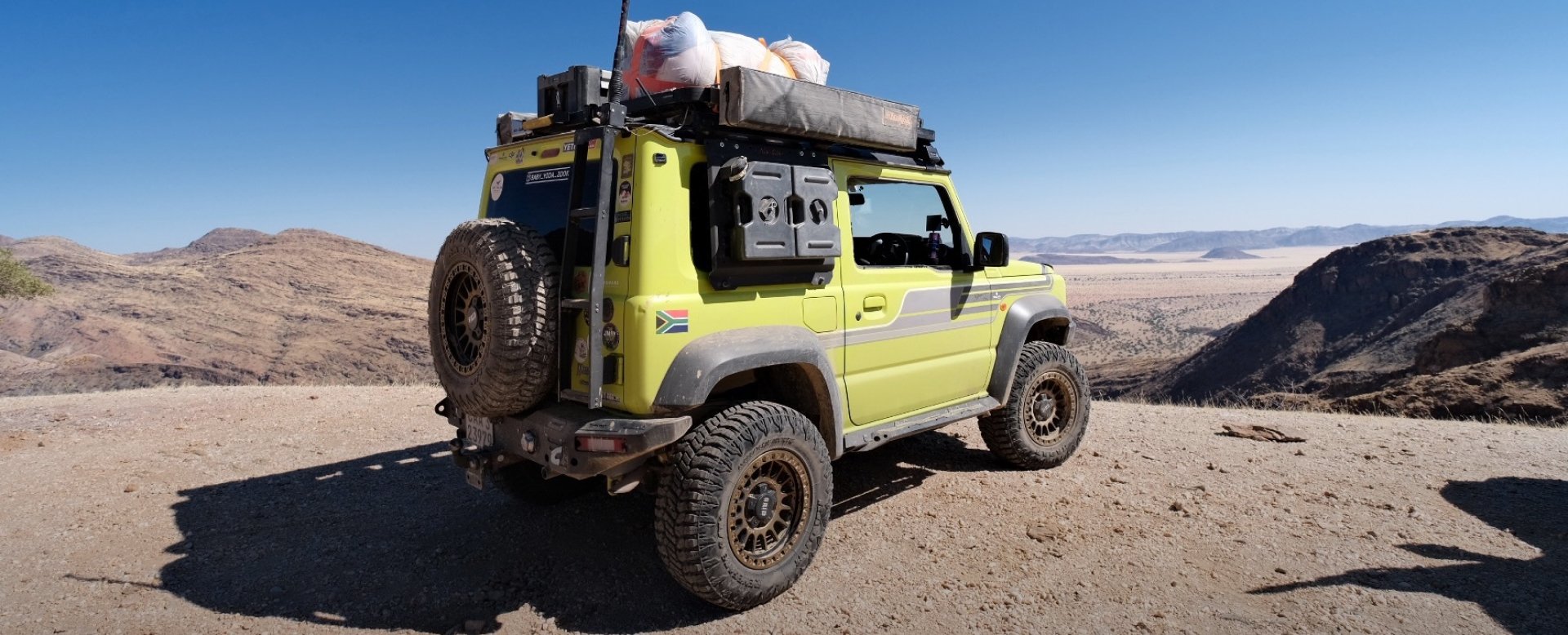
That’s where the Jimny is very different from our more road-focused models. Both the Jimny and Jimny 5-Door use ALLGRIP PRO part-time 4WD with a low-range transfer gear, along with 210 mm of ground clearance, giving them the hardware for proper off-road driving rather than simply extra grip on a loose road.
.jpg?width=1920&name=Jimny%20Desktop%20(1).jpg "Jimny 3 and Jimny 5 Door")
Is AWD enough for dirt roads, or do I need 4WD?
For most maintained gravel and dirt roads, AWD is plenty. In fact, many can be driven perfectly comfortably in a two-wheel-drive car.
You start to need the extra capability of a traditional 4x4 when deep sand, mud, rocks, steep gradients, or badly rutted tracks become a regular part of the drive.
AWD helps you find grip. It doesn’t give a low car more ground clearance or turn road tyres into off-road tyres.
The specs worth checking
A car doesn’t become capable on rough roads because it has chunky black cladding. If gravel or dirt-road driving features regularly in your life, these are the details worth checking:
Ground clearance
More space underneath the vehicle means more room to clear ruts, stones and raised sections of road. Cars with high ground clearance have an advantage when uneven surfaces are a regular part of the route.
Tyres and wheel size
Tyre profile, tread, and construction affect grip and how well the tyre handles potholes and sharp impacts. If you regularly travel far from towns, the availability of replacements is worth considering, too.
Suspension
Suspension has to keep the tyres in contact with uneven ground while controlling the vehicle over bumps and corrugations.
Traction and stability systems
Electronic stability control and traction control can help when surfaces become loose or slippery.
Underbody protection
The rougher the terrain, the more exposed the components underneath the vehicle are. Dedicated off-road cars are more likely to offer protection designed for this kind of use.
Off-road angles
For serious off-roading, approach, departure, and breakover angles indicate how easily the vehicle can negotiate abrupt changes in terrain without its body contacting the ground.
What about long-term wear on gravel?
Frequent gravel driving puts more work on tyres, wheels, and suspension than smooth tar does.
Corrugations keep the suspension moving constantly. Potholes can affect alignment or damage wheels and tyres. Loose stones and uneven sections also make ground clearance and underbody protection more relevant.
Hatchback durability on gravel depends heavily on the road itself and how the car is driven. Maintained gravel at a sensible speed is a very different proposition from regularly tackling deep ruts and badly broken surfaces in a low-clearance car.
There are ownership trade-offs at the other end of the scale, too. A traditional 4x4 may be better equipped for tough conditions, but larger tyres, additional drivetrain hardware and higher fuel consumption can make it more expensive to run.
For a budget-conscious driver, the lowest-cost vehicle for rough roads is usually the least specialised option that can handle them comfortably.
Stability and safety on loose roads
Loose gravel gives you less predictable grip than tar, particularly when braking or changing direction quickly. Electronic stability control and traction control can help manage wheel slip and unwanted vehicle movement, but tyre condition and speed still play a big role.
Vehicle height matters too. Hatchbacks generally sit lower, while SUVs and 4x4s gain useful ground clearance by sitting taller. Taller vehicles also tend to have a higher centre of gravity, so sudden steering inputs or carrying too much speed into a loose corner can increase the risk of rollover.
Whatever you’re driving, gravel rewards smooth steering, sensible speeds and a bit more space between you and the car ahead.
So, which vehicle class handles rough roads best?
It depends on how rough we’re talking.
If your week is mostly tar with some maintained gravel, a hatchback may be all the car you need.
If you regularly switch between tar, gravel and rougher rural roads, a compact SUV gives you useful extra clearance without going straight to full 4x4 territory.
If mud, sand, steep climbs, deep ruts and rocky tracks are part of normal life, then you’re asking for proper off-road capability.
And if your “rough road” is the gravel stretch to the campsite twice a year? You probably don’t need to buy your daily car for those ten kilometres.
There’s a Suzuki for the school run, the gravel shortcut, the farm road and the track that makes you wonder whether it still technically counts as a road. The trick is choosing enough capability for the adventures you actually have, rather than paying for a whole lot of vehicle you never get to use.
Find the perfect Suzuki for your next adventure now!

.jpg)